Towards Climate-Neutral Operations
We are committed to promoting renewable energy solutions and climate-efficient operations.
Color Line’s ambition is to achieve climate neutrality by 2050. More than 99% of the company’s own greenhouse gas emissions originate from fuel consumption by our vessels. Measures related to the fleet therefore represent a key pillar of our sustainability strategy.
Goals and ambitions
-
Goals for 2030
- 55% reduction in carbon intensity, measured from the year 2000
- 10% reduction in fuel consumption for our vessels, measured from 2019
- Shore power in all our ports
- 30% reduction in electricity consumption related to the operation of our shore-based locations, measured from 2019
- Carbon-neutral port operations and company vehicles
-
Ambitions for 2050
- Achieve climate-neutral operations, given the development and availability of zero-emission technologies.
Our Key Initiatives
Energy efficiency
Towards 2030, our focus is on reducing fuel consumption year by year through a wide range of energy-efficiency measures. Several initiatives have already been implemented, with additional improvements planned in the coming years.
Route optimisation and schedule adjustments
We continuously analyse and adjust our routes to identify the most efficient sailing patterns. By optimising speed and sailing profiles, we reduce fuel consumption. During low and shoulder seasons, schedules on selected vessels, including M/S Superspeed 1 and 2, are adjusted to avoid unnecessary fuel use.
Hull and engine improvements
Our vessels undergo technical upgrades to improve energy efficiency. Regular hull cleaning reduces water resistance, and minor engine adjustments enhance fuel utilisation.
Propeller replacement
The propellers on M/S Superspeed 1 and 2 will be replaced and optimised for the vessels’ actual average operating speed rather than theoretical design speed, resulting in reduced fuel consumption.
Environmentally friendly hull coatings
Several of our vessels, including M/S Color Magic, M/S Superspeed 1 and M/S Color Fantasy, are equipped with silicone-based hull coatings. These reduce friction in the water, leading to lower energy consumption and emissions.
Increased use of biofuel
We are testing and implementing biofuels on several vessels. Increasing the share of biofuel is an important step towards reducing emissions in the years ahead.
Shore power in port
When our vessels are berthed in ports in Norway and in Kiel, they connect to shore power instead of running their own engines, significantly reducing emissions. We are also working with the ports of Hirtshals and Strömstad to enable the use of shore power there by 2030.
Fleet development
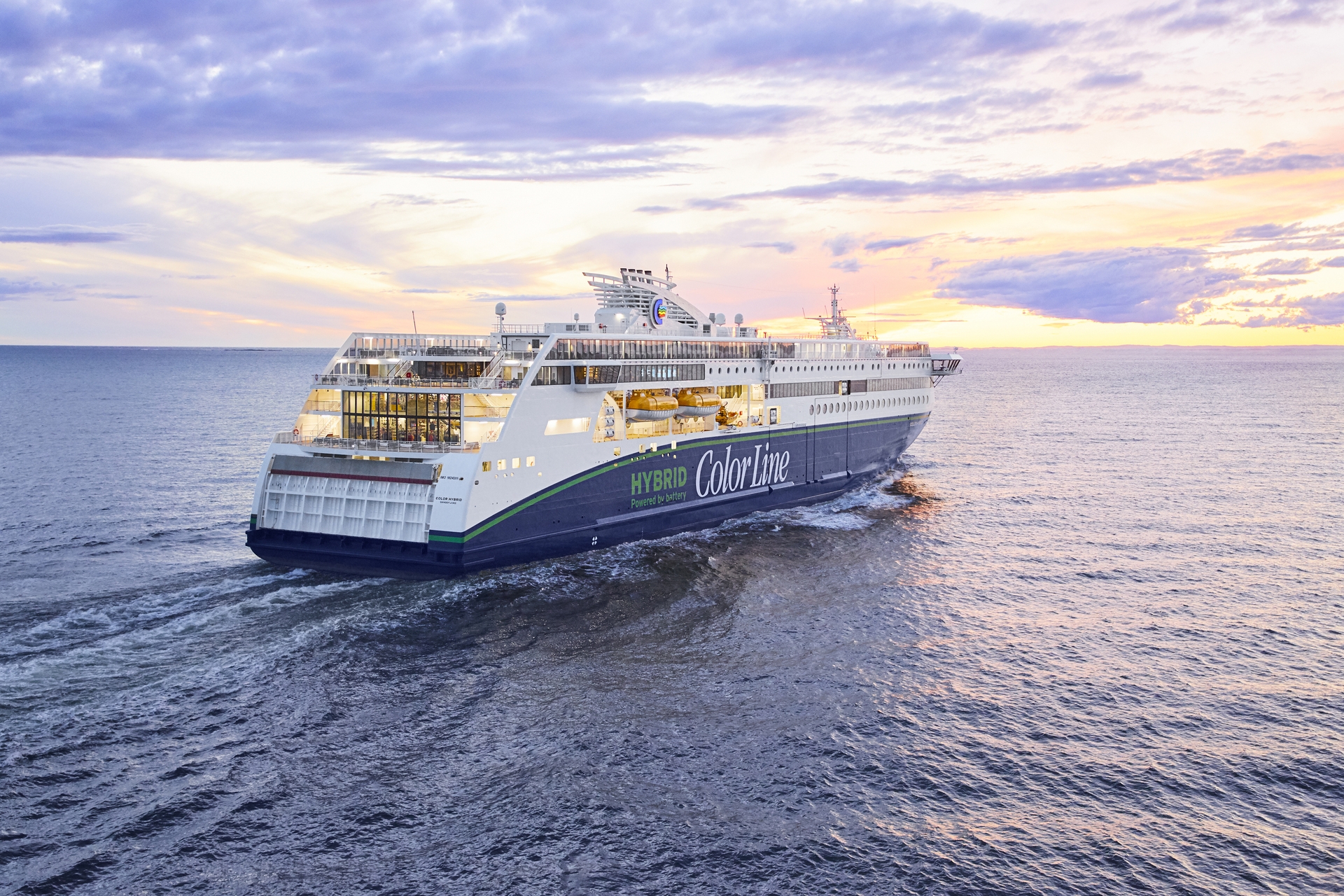
Color Line’s current fleet consists of modern and energy-efficient vessels built between 2004 and 2019, including one of the world’s largest plug-in hybrid ships, M/S Color Hybrid. The sale of M/S Color Viking and M/S Color Carrier in 2022 marked the final phase-out of older tonnage. Today, all vessels in the fleet are designed and built specifically for the routes they operate.
To achieve a climate-neutral fleet by 2050, further fleet development will be required during the period 2030–2050. This will involve the gradual introduction of new technologies and zero-emission solutions, in close cooperation with leading stakeholders in battery technology, port infrastructure and regulatory frameworks.
Full electrification of M/S Color Hybrid (2030–2040)
M/S Color Hybrid already operates with battery power, but its capacity must be increased to enable zero-emission operation over longer distances. This requires access to shore power in both Sandefjord and Strömstad. The vessel is technically prepared for this expansion, and regulatory barriers are relatively low. Color Line is in dialogue with the relevant Swedish authorities to facilitate this development.
Hybridisation of routes between Norway and Denmark (2030–2040
We are exploring opportunities to partially electrify routes between Norway and Denmark. This involves the use of large battery systems combined with multi-fuel solutions based on zero- or near-zero-emission fuels. Both retrofitting existing vessels and developing new ships are being considered. This transition depends on extensive port infrastructure, including high grid capacity, charging solutions and potentially energy storage, as well as advanced onboard technologies.
Large-scale solutions for long-distance routes (2040–2050)
During the period 2040–2050, our focus will shift to the Oslo–Kiel route. Achieving zero-emission operations on long distances will require more advanced technologies. We are assessing both the conversion of existing vessels and the development of new zero-emission ships. Decisions will be based on further technological progress and close collaboration with industry partners and authorities.